Friday, February 20, 2009

E-Journal Entry 2- February 20, 2009

Exploring the Secrets Behind the Island


Americans loves to watch themselves on TV and in the movies. We watch our lives relayed back at us in more interesting and dramatic story lines and we love how easy their lives look. However, film and television is more complex and deeply thought out than most of us understand. There is more to a film than it's story; in fact, producers and designers make thousands of decisions on camera shots, clothing, casting, editing, music and more. This concept of "form" allows us to take a deeper look into American culture and what is being shown on our media. In my second E-journal I will analyze the hit TV drama "Lost" from ABC.

Lost is in its fifth season and is still leaving viewers with unanswered questions and surprising plot twists. In the following paragraphs, I will analyze clips and characters from the show and try to understand better how the visual design, cinematography, and sound design influence the story and theme.

Lost (2004) is about the 48 survivors of Oceanic Flight 815 after the plane mysteriously crashed miles off track on a deserted island. However, their island holds many secrets and in order to survive the characters must learn to not only live with each other but with the many other unexpected events. Viewers not only watch their journey on the island but witness flash backs that interconnect many of the main characters. Characters come and go on the island, but one thing I find interesting is the diversity of the characters.

Major Characters on Lost: Current and Past

Mr. Eko

Sun Kwon

Jack Sheppard
Desmond Hume

Hurley
Kate Austen
Sayid Jarrah
Juliet Burke
John LockeMike Dawson and Walt (son)Ana-Lucia Cortez

Of the nine characters shown above (which are only some of the main characters) only five of them are white, and they all come from very diverse backgrounds. Also, Hurley, an overweight character, isn't cast as a "typical overweight man". His weight isn't a major issue in the story line and when it is, it is never a joke, unlike many mainstream television shows.

The producers chose to use a VERY diverse cast yet kept all of the characters interconnected. All of the characters are tied together throughout the episodes. This is purposefully done by the writers and is an example of visual design. They chose to keep these characters as a dominant part of the show despite their race or religion. They are not presenting a white power view, instead, they show a multicultural view with their characters and react against many shows who "subconsciously" leave Mexican and black actors as villains or low class roles. In Season 3, Ana Lucia is shown as a hero who saves the survivors of the other half of the plane and connects them with their fellow castaways. I applaud Lost for casting diverse roles in race, gender, and religion and matching this aspect of visual form with their editing, sound and lighting to create nontraditional multicultural characters that are portrayed in a positive light.

Cinematography and Sound Design in Lost
Yet, it is more than the character and casting choices that help send out the message of Lost. However, one warning once you realize the impact of form in films, you ALWAYS realize the impact. Nonetheless, it still is important to understand the underlying influences in a media clip and cinematography and sound design play huge roles in the overall theme of the message.
Griffen and Benshoff explain cinematographic design as, "...how the camera records the visual elements that have been dictated by the literary design. The cinematographic design includes things like the choice of framing, lenses, camera angle, camera movement, what is in focus and what is not." (p. 4)
The following clip is from season 3 and it depicts how the "Others" witnessed the plane crash. It is important to focus on the last minute and a half of the clip and how the camera changes to emphasize the message.

This clips uses stunning camera focus and angle to keep the tension in the clip and drag the audience along. After the "earthquake" the camera comes to the center of the yard and captures all of the "Others" running out of their houses from all directions. It then focuses in on Ben, who the camera angles make the leader of the group. The most effective camera angle is in the last :30 seconds when the camera veers away from the whole group and focuses in on the man running to meet the plane. He becomes smaller and smaller until he is a blur, and at that point the camera zooms out to show just the village, then the clearing the village is in and continues to progressively zoom out until the whole island is in view. This shows how this one small action is affecting the whole island. It forces the audience to think about the man's role and how it has and will effect the survivors. Depending on where the camera points or focuses it helps allow the viewers to understand what and who is important right now.

The following clip is from an episode when John Locke tries to convince everyone that they do not need to press the numbers in the hatch, as they have been for every 108 minutes. The show uses excellent sound design to display the power and effects of the John's decision.

The clip immediately starts out with a brisk, all-business female voice that is repeating "system failure, system failure." Her voice is just the beginning of the strained sound effects in the hatch. The camera constantly switches back and forth between Locke and Desmond and the dark, dim scenery is countered by dramatic music. Even more, when the objects start flying in the background, the sound of their movement overpowers the whole scene. In fact, the only time the dialogue is a focus is when Locke admits his mistake. At that point, he becomes the center of attention and the music dies out. This emphasizes the critical decision he made, and the producers are showing how important and maybe poor it was. By making his statement clear, they are forcing the audience to listen.

The clip ends with Desmond inserting the key and the bright light covering the island. Accompanying the light, is a loud, blaring noise to show the confusion and momentum of Locke's decision. Finally, it ends with silence. The sound effects with this clip make it much more powerful than just the dramatic lightening and camera changes.

Analyzing form is vital in a complex and confusing show like Lost, where the content doesn't explain everything to the viewers. The producers must use design, visual, and sound effects to clarify their message. I analyzed visual, cinematography, and sound design in specific clips of Lost; however, I still don't understand everything yet...and it's almost guaranteed that Lost has another new trick for the next episode that will leave us with more questions. But, at least now we have a few tools to help us find the answers.

Wednesday, January 28, 2009

E-Journal Entry 1- January 28, 2009

Media is omnipotent. It’s everywhere…that simple. Yet, we often don’t take time to analyze the effect media plays on us and the dominating role media and its corporate counterparts play on our society. Every Tuesday and Thursday afternoon, a meeting of the minds concurs in NDSU’s Politics of Popular Culture, where we dissect the true hold media has on society.

Politics of Popular Culture (PPC) is more than just watching TV and looking at ads; it’s about answering the questions and dissecting the concepts presented to us. What is the feminine ideal? Does media’s portrayal of gender really affect our own gender identity? Is there a “crisis of masculinity”? We may have to face that some of the questions may never be truly answered, but as media critics we need to realize that they do actually connect to our real life media intakes.

ABC’s Desperate Housewives is a cultural phenomenon. The show last Sunday, Jan. 25 (which was a re-run) attracted just over 6.5 million viewers, according to TV by the Numbers website. Men and women alike are attracted the primetime “soap opera” shown every Sunday evening, and I admit, I am one of the 6.5 million viewers who tuned in last Sunday. I am a Desperate fan.


But, maybe it’s time for me to analyze the gender roles and stereotypes Desperate portrays. Maybe there is more behind the drama filled storyline than I thought.

David Gauntlett brings attention to interesting and realistic concepts on gender portrayals in his text: Media, Gender and Identity. With the help of class discussions and Ganutlett's text, I am going to dig deeper into his idea of "demasculizing" male characters. Finally, I will dissect the female stereotypes created in the show and bring attention to the combination of "post-feminism" characters while still using 1950 and 1960's traditional ideals.

Morphing Male Characters and Tempering of "Machismo"

From Mike, the plumber, to Orson, Bree's devoted husband, or Tom, the house-dad; Desperate has created many levels to their male characters.

"...the depiction of masculinity has become less straightforward, and more troubled," Gauntlett points out in chapter four.

For example, Carlos, Gaby's (Eva Longoria) husband was once a greedy, rich business man and gave Gaby whatever she wanted, but when he lost his sight and couldn't work, his stereotypical arrogant male character disappeared. In fact, Carlos didn't want to go back to his powerful career, he wanted to help others, and in this case, his sensitive and caring personality won out.


Another example of the more complex, multi-level male character is shown through Orson, Bree's husband. Orson is created to be a much more feminine male character. As cliche as it is, "it is obvious who wears the pants in the family" and it isn't Orson. For example, watch this clip where Bree was bluntly called out for demasculizing her husband. (This is the full episode, the clip I am pointing out starts at 7:00 and ends at 8:35. You may possibly have to click into Episode 12.)

However, Orson doesn't always mind. He understands the role each partner plays in the relationship and appreciates the agreement that they have came too. Later in the show, he points out to Bree how he respects her dominating role in their household.

I don't think we consider enough analyzing the male characters in dominating female shows, but nonetheless, I think Desperate Housewives is very modern in their male gender identities. Just like many TV ensembles, each character has their own quirks and differences, but on Desperate they stay consistent by giving males a more complex personality. I applaud them, because I feel they created realistic male characters.

The Ladies of Desperate Housewives:
A Combination of Post-Feminist and Traditional Roles

Directed towards female audiences, Desperate Housewives has many different types of women characters that reflect the variety of women in the world today. One thing to point out, it that Desperate does break from traditional norms in gender ratios in media pointed out by Gauntlett on page 63 of his text:

In prime-time TV shows, 1992-1993, men took 61% of the total number of speaking roles, with women having the other 39%. The 1995-96 study found that men took 63% of the speaking roles, with women having the other 37%.

Desperate is an out lier, especially as the five main characters of the show are female. The whole storyline focuses on their drama filled lives, and their husbands/love affairs are just a spin off.

More importantly though, each woman has her own character with flaws and strengths. Yet, even with their differences they all are a symbol of the feminine character portrayed today on television. I especially want to bring attention to the combination of "postfeminism" and traditional femininity characteristics in the Desperate ladies. This analysis is similar to my last critic on the multi-level male as I believe that today we also witness the multi-level female and the
media mongrel of Desperate Housewives encourages it.

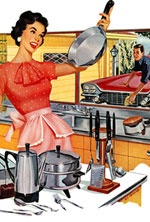
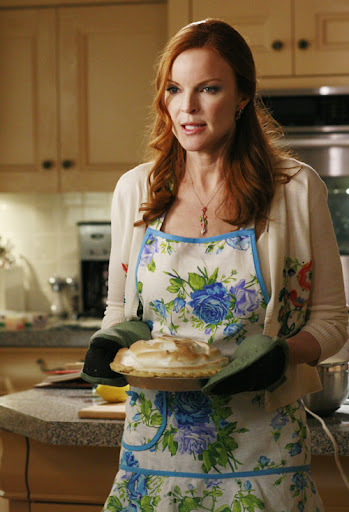
One of the characters that show a traditional representation of gender in the past is character, Bree Van De Camp, played by Marcia Cross. Bree is the typical 1950's housewife...in some sense.
When comparing both pictures, it's easy to find similarities. The first picture is a classic image of the 1950's housewife that was the cover of many magazines. Gauntlett explains the image of "blissful domesticity" is more than a stereotype, however.

" The advice offered to women was not about how to fulfill their own potential, but was instead focused on bringing happiness to their family. Unlike some stereotypes, this one was based on reality: these mags and ads really did exist," Gauntlett explains on page 54 of his text.

However, while Bree may appear to be the "perfect housewife" as ABC's website for the show describes, she still isn't the typical 1950's stereotype. Bree excels in classic femininity in the way that she entertains and presents a perfect household, but Bree's dream isn't to "to impress her authoritative, working husband by using the latest kitchen accessory or washing powder," like Gauntlett claims was the typical housewife's goal.

As I previously mentioned, Bree normally dominates her relationships. She doesn't keep up her charade for her husband, she chooses to keep up the charade for herself. This is an example of "post feminism backlash," a concept we discussed in class.

After the push of feminism, we saw many texts alter their female characters to reflect the new ideals.

"Some shows, of course, put successful professional women at the forefront, and have focused on their quests for sex, pleasure and romantic love," Gauntlett writes on page 65 of his text.

Desperate Housewives is one of those shows that fit perfectly in the "post feminism" age. It shows strong characters that want more out of life than a family and a husband. The women are not afraid to show embrace their sexuality and be proud of being temptation to men. Their sexuality is brought to the forefront with their ad below. The actresses are laying in a bed of apples, referring to the temptation of Adam and Eve and playing up their control over men and pleasure.


While the show contrasts with gender representation of the past, it still points out a very important concept that came about as a reaction to the feminist movement: that women have the right to choose.

Bree Van De Camp is a perfect example of how media today often blends different generational representations of women. Bree is the 1950's housewife, but she has strong personal values and is independent of her husband. This character recognized the need for gender equality that is represented in today's media, however, she chose to continue on with the traditional role women played in the past. Her "backlash against feminism" isn't much of a backlash, but is more of a personal choice to keep strong the good parts of femininity of the past with modern ideals of today.

Conclusion
Desperate Housewives may be a "prime-time soap opera" to some, but it also is a useful text for analyzing gender stereotypes. The show is atypical as it is a female dominated show, but it still provides insight on both male and female media representation. The male characters show many different complex levels to their personality, something that Gauntlett points out as a growing trend in media. The female representation is similar though. Media is addressing the issue of "post- feminism" but it is even going one step forward and acknowledging the idea of "feminism backlash." Many characters on the show embrace their sexuality and independence, while also striving to maintain a working, functional household for their families. They chose to embrace both traditions of today and of the past to create a more balanced character. I appreciate that both can be represented in the show, because I feel many young women hope that for themselves some day. These multi-level characters are a step in the right direction since, let's be realistic, they exist in everyday life.